
by Mike Rich, Arriola Sunshine Farm

Cyprus mouflon (Ovis gmelini ophion), 2019 hchavez, Creative Commons
Sheep were domesticated between 11,000 and 9000 BCE in Western Asia (Iraq, Iran, Turkey). The Asiatic wild mouflon is widely believed to be the primary ancestor to all modern domestic sheep. Wild mouflons have a short-haired, reddish-brown coat with a bristly outer layer that does not shed. Domestic sheep began spreading to Europe about 6000 BCE and reached Scandinavia by 4000 BCE.
From earliest times, sheep were a major source of meat, pelts, leather, lanolin and milk. Early domesticated sheep had hairy coats that needed to shed. Today’s Soay breed resembles these early domestic sheep. Selective breeding specifically for wool began around 6000 BCE. Early woven wool textiles date to between 4000 and 3000 BCE. Medium and finer-wooled breeds emerged around 500 BCE. Highly specialized fine-wool breeds such as the Spanish Merino were developed in the 12th-13th centuries. Domestic hair sheep breeds originated in Africa and have a coat of hair, not wool, and are used primarily for meat and leather. Worldwide, there are an estimated 1,000 sheep breeds that thrive in every environment from alpine peaks to deserts. Each breed has evolved through various degrees of natural selection and human selection for traits.
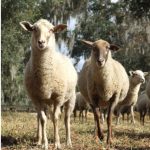
Florida Cracker sheep
Domestic sheep were first introduced to North America by the Spanish, who brought with them several hardy Iberian Churra breeds capable of thriving in rough conditions and able to produce milk, meat and wool for settlers. The first introduction was in Florida in 1493, then in Mexico in 1519, and again in 1540 in what is now the Southwestern U.S. These breeds are the foundation from which the Florida Cracker, Gulf Coast Native and Navajo-Churro breeds were developed. Likewise, hair sheep from Africa were brought to the Caribbean by Spanish traders, from which the Barbados Black Belly and St. Croix hair sheep were developed. Later, in 1607, the English introduced several hardy, unimproved small types of sheep, designed for survival and local wool production, to their colonies. Today, there are approximately 50 sheep breeds in the United States, of which 23 are listed on The Livestock Conservancy’s Conservation Priority List.
In the western United States, regional cultures, economies and lifeways developed around the shepherding of sheep and weaving of textiles and fiber art. Flocks, often numbering in the tens of thousands, were moved seasonally (transhumance) from winter to summer rangelands, often over hundreds of miles. Traditional pastoralism adapts to climate, provides ecological benefits like wildfire resilience and preserves cultural heritage. This system relies on the labor of sheepherders and dogs to protect sheep from predators. Hardiness, intelligence and ability to raise their offspring with little assistance were essential. In the fall, flocks were driven along stock ways to be loaded onto trains bound for markets.
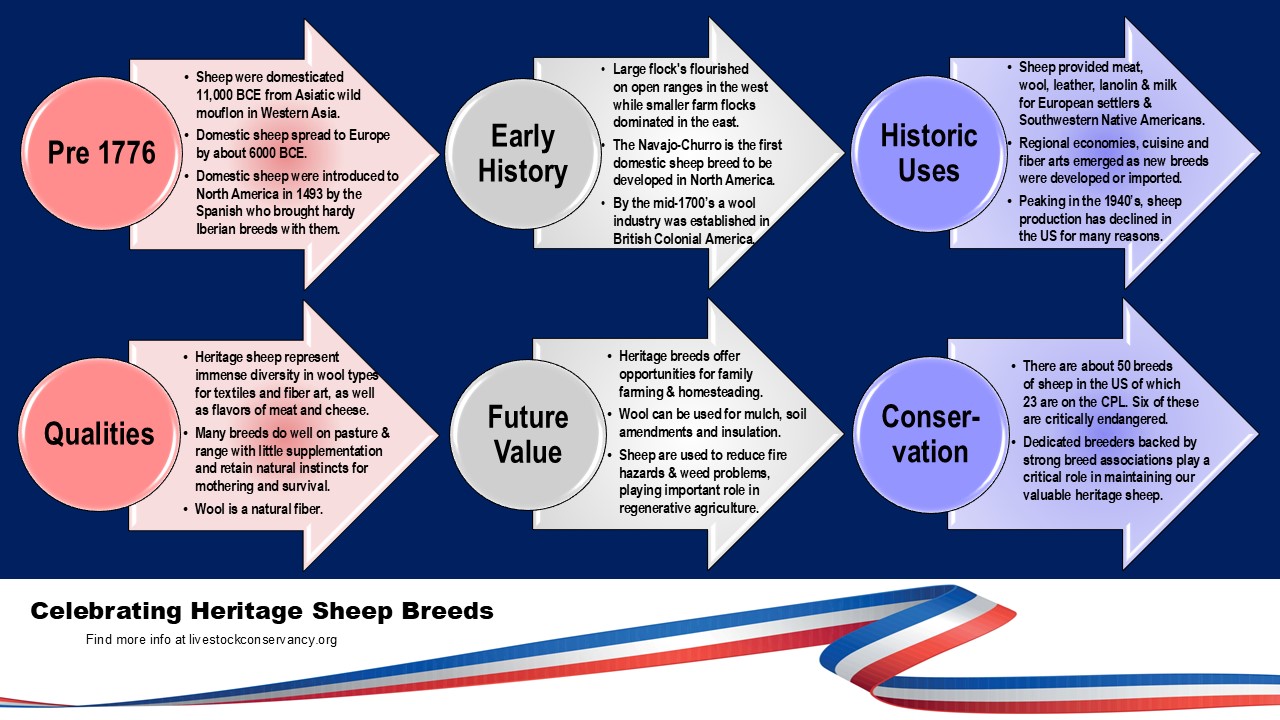
Click for a Timeline of Heritage Breed Sheep in America.
In the eastern U.S., Sheep were raised at a smaller scale on pasture, often with shade, and could be easily supplemented with hay and grain. Most sheep were raised for home-spun wool, but they also provided meat and helped to clear land. In the Appalachians, bald mountain tops were used as summer pastures. In New England, the “Great Sheep Boom” of the 19th century, where demand for wool increased dramatically due to economic policies, led to the clearing of land and the construction of extensive stone walls and split-rail fences to contain flocks. At the same time, large mills were built to process wool and create woolen products.
The U.S. sheep and wool industries remained robust through the mid-20th century. Sheep production shifted towards finer-wooled breeds and those that produced quality meat more efficiently. At the peak, there were 50 million sheep in the United States, according to the United States Department of Agriculture census of 1940. After World War II, the demand for lamb and mutton declined, and competition from New Zealand and Australia drove wool prices down. By the late 1970s, many sheep producers had shifted to raising beef cattle. Today, there are about 5 million sheep and few woolen mills left in the United States. The industry is focused primarily on about 10 standardized industrial breeds; however, recognition of the value of genetic diversity offered by heritage sheep is growing.
Heritage sheep offer opportunities for family-based farms and ranches to find viable niches for the products they create. Heritage sheep, especially the smaller breeds, are ideal for children, helping them learn the nuances of breeding livestock. Each breed offers a variety of distinguishing characteristics and traits, such as
- heavy milk production for soaps, specialty cheese and fudge
- wool types and colors suitable for many products and prized by fiber artists.
- excellent meat both in flavor and quantity
- strong mothering and flocking instincts
- the ability to flourish on grass pasture or rangeland with minimal supplementation.
- exceptional in regenerating soil health and managing vegetation
The processing and spinning of wool into yarn for wearable clothing and fiber art is deeply embedded in American history and culture. Some people say that the sheep’s superpower is converting grass to wool because it aligns well with sustainable consumption choices. Unlike synthetics, wool does not release microplastics into the environment and it breaks down naturally. For this reason, wool is celebrated as an eco-friendly material in fashion, home décor and construction. In addition, it is ideal as a soil amendment and protective mulch.
Special thanks to The Sheepwalk Ranch for sponsoring Celebrating 250 outreach and content about sheep. Visit them at www.thesheepwalkranch.com.
If you’re considering sheep ownership, you can learn more about each heritage breed on The Livestock Conservancy’s Conservation Priority List at https://livestockconservancy.org/heritage-breeds/conservation-priority-list/.
If you’re ready to purchase sheep or want to talk with a breeder, you can most likely find what you’re looking for in our online Breeders and Products Directory at https://livestockconservancy.org/heritage-breeds/breeders-directory/
If you would like to support the ongoing work of The Livestock Conservancy, you can become a member or make a donation at https://livestockconservancy.org/
Raising awareness of heritage breeds is the first step to preventing their extinction. You can help by following our Facebook or Instagram page and sharing our posts to spread the word. https://www.facebook.com/livestockconservancy


