
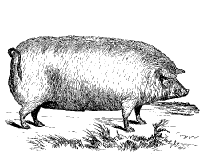
Breed Facts
Status:
Threatened
Use:
Meat, Lard/Back Fat
Adult Weight:
Male – 600 lbs.
Female – 500 lbs.
Temperament:
Docile
Experience Level:
Beginner – Intermediate
Notes:
Good mothers; May be used for Loin, Roasts, Ham, Bacon, Sausage/Ground, and other retail cuts
GLOUCESTERSHIRE OLD SPOTS
Gloucestershire Old Spot pigs (GOS), are recognizable by their distinctive white coats with black spots, large lop ears, and their docile nature. The breed is thought to have been developed in the Vale of Berkeley in Gloucestershire, England during the 1800s. The oldest pedigreed spotted pig breed, the GOS was common on small family farms, thriving on dairy by-products (whey), windfall fruits in orchards, and cider pressings. These gave the pigs the nicknames “cottage pig” and “orchard pig.” British folklore claims the large black spots were bruises caused by apples falling onto them as they foraged the orchards for food.
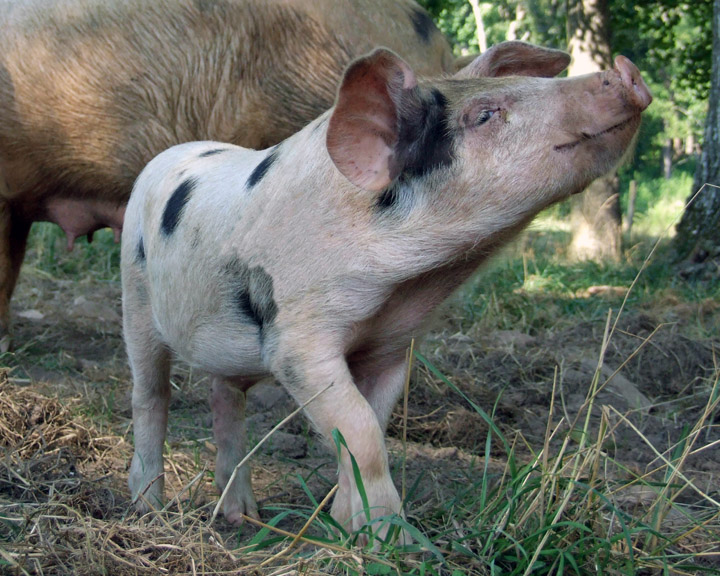
Gloucestershire Old Spots Piglet
Like many breeds originating before the 20th century, the exact history and ancestry of the Old Spots pig is unknown. GOS pigs were first mentioned in English literature around 1790. The most likely origin is a pairing of the original Gloucestershire pig (a large off-white pig with floppy ears and wattles) and the unimproved Berkshire (a sandy colored pig with prick ears and black spots). Both breeds are now extinct. One other possible contributor is the Lincolnshire Curley Coat, which has also gone extinct. These breeds were thrifty, hardy and excellent foragers that supplemented their feed with roots and vegetation, had excellent maternal instincts, and an even temperament.
In 1913, the British Board of Agriculture announced a livestock development plan that included the licensing of breeding boars. Farmers of the Berkley Vale realized this plan threatened the existence of their beloved local pig breed, so in November 1913 they formed the Gloucestershire Old Spots Breed Society and compiled an official herd book.
The breed reached its peak popularity in Great Britain just after World War I when the naturally large proportions of lean meat from Old Spots was perfectly suited to the production of lean, streaky bacon that was popular at the time. Old Spots reigned supreme as the pork of choice for discerning palates. Unfortunately, the breed became rare after World War II when the shift to intensive pig production diminished the use of pigs that were bred to thrive outdoors.
Old Spots genetics were used in America in the 20th century to create breeds like the Spotted Poland China, the Chester White, and the American Spot, but purebred GOS pigs never became popular in the United States. By 1977, they neared extinction in Great Britain. To revive the purebred GOS population in the US, the Kelmscott Farm Foundation in Lincolnville, Maine, organized an importation of 20 GOS piglets in 1995. One year later, a breed organization called Gloucester Old Spots of America, Inc., was founded to maintain the breed and institutional records. Preservation efforts in Britain and American are ongoing, though the breed is still endangered in both countries. The breed benefits from the continued support of the British Royal Family, which favors the sweet, well-marbled pork for their table.
The Gloucestershire Old Spots pig is known for its calm nature, ease of handling, and its hardiness in outdoor rearing conditions. The breed is large, with boars reaching mature weights of 600 pounds and sows reaching 500 lbs. The sows’ maternal skills enable them to raise healthy litters on pasture. Their disposition and self-sufficiency make the GOS attractive for farmers raising pasture pigs and for diversified operations.
Did you know:
The Dominique chicken is America’s oldest chicken breed and was widely raised on farms in the 1800s. Did your grandparents raise “Dominikkers”? Learn more about this beautiful but threatened breed at Dominique chicken – The Livestock Conservancy