
Breed Facts
Status:
Threatened
Use:
Meat, Lard/Back Fat
Adult Weight:
Male – 175-200 lbs.
Female – 85-150 lbs.
Temperament:
Docile
Experience Level:
Beginner
Notes:
May be used for Suckling BBQ, Charcuterie, Sausage/Ground
GUINEA HOG
The Guinea Hog is a small breed of swine that is unique to the United States. Also known as the Pineywoods Guinea, Forest Hog, Acorn Eater, and Yard Pig, their descriptive names reveal the utility of this breed in diverse homestead settings.
Written records indicate that the Guinea Hog was present in the American South at least as early as 1811. However, the exact origins of the Guinea Hog are unknown. There may be a link to hogs imported to America during the colonial period, as noted by Thomas Jefferson and other Virginia farmers. At minimum, the Guinea hog was in wide use in America for at least two centuries. In rural America, this breed thrived on small family farms and homesteads.
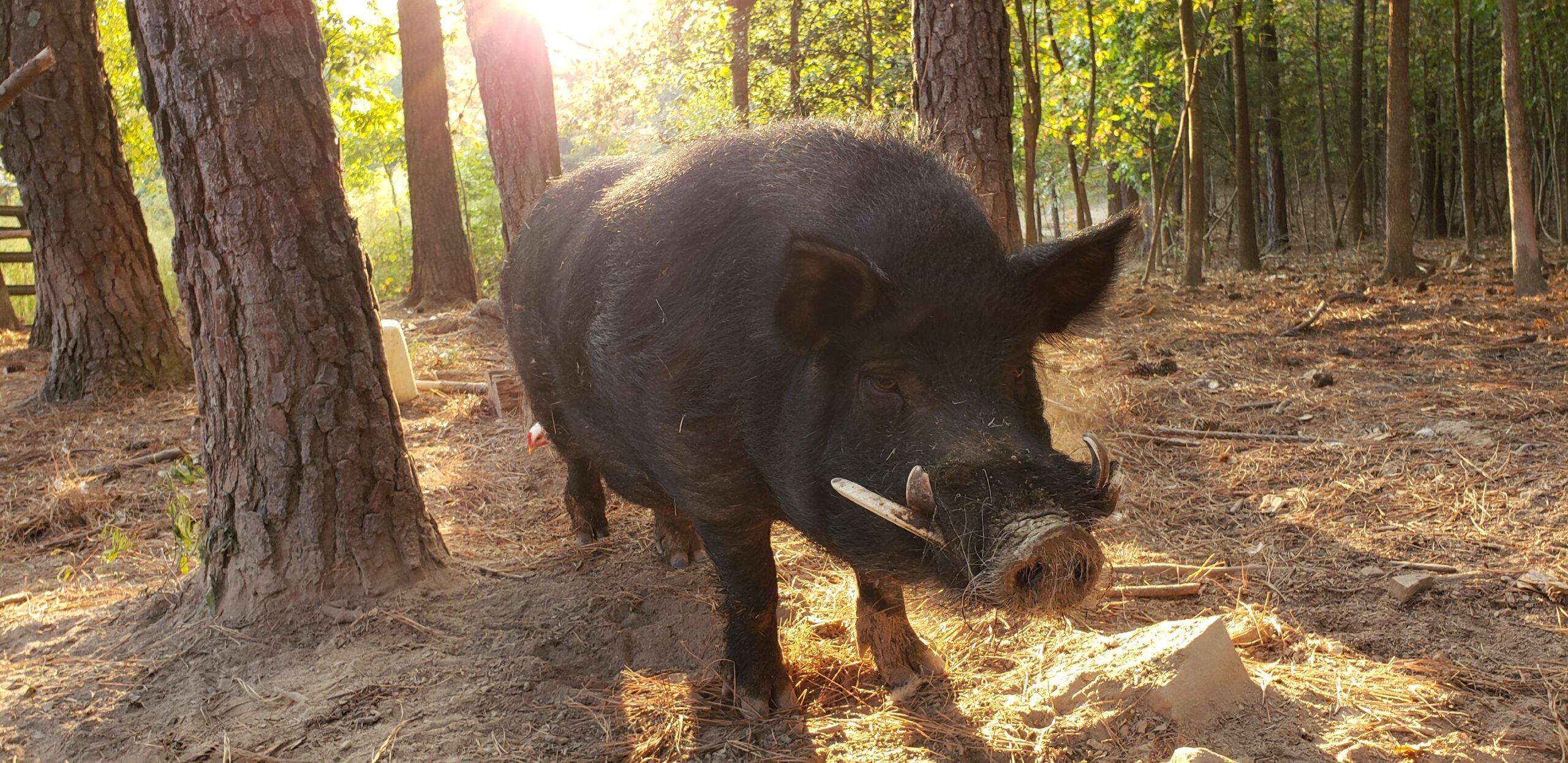
Guinea Hog Boar
On the farm, Guinea hogs worked for their living. They foraged for much of their own food, ate rodents, and cleaned out garden beds. Small, hardy, and metabolically efficient, they gained weight on the roughest of forage and produced the high-quality hams, bacon, and lard important for subsistence farming.
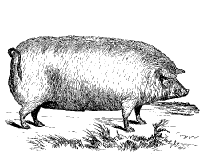
Descriptions of pigs from one farm or locality to another often varied depending on local environmental conditions or the preferences of the farmer. Some family or regional herds have longer or shorter noses, and some have heavier or lighter frames. Regional differences in characteristics are typical of “landrace” breeds, which derive their traits through adaptation to the area in which they live or to the production system in which they are maintained. However, all Guinea hog descriptions noted their small size, hairy black or blue-black coat, upright ears, amber to brown eyes, and curly tail.
The once common Guinea Hog became rare in the mid-late 20th century when the habitat of the homestead hog began to disappear. The breed survived mainly in isolated farm populations. In 2009, it was estimated by the American Guinea Hog Association that there were fewer than 400 Guinea hogs in the United States.
Since that time, the number of herds has grown, due in large part to the increased interest in traditional farming methods that utilize pigs for diversified, sustainable agriculture. Today’s Guinea hogs remain well-suited for ranging in woods, orchards, and pastured land where they can forage for much of their own food; however, a complete diet should be provided to meet the pigs’ nutritional requirements at each life stage. They grow fat easily on excess grain and can become obese when overfed, which can negatively affect their fertility.
Guinea hogs do not produce a conventional market carcass since they are smaller pigs. For the small farm or homestead, though, Guinea Hogs are a superb choice for families that desire a smaller breed or for those with limited freezer space. Along with their ability to thrive on lower inputs, their good temperament and small size make them easy to manage. Boars reach an adult weight of 175-200 lbs and sows 85-150 lbs.
Male and female Guinea hogs can reach sexual maturity as early as 3 months of age. It is important to separate intact males and females by three months of age to prevent unintended breeding. The recommended breeding age for Guinea hogs is between 8-12 months. Breeding at this age increases the likelihood of healthy litters and improves the mother’s lifetime production. Breeding twice a year, and before the age of two, supports fertility throughout the sow’s breeding years and yields the most meat and replacement stock. Well-managed sows can live up to 14 years and continue to raise viable litters of 6-10 piglets for much of their lives. Boars can produce viable offspring into their late teens.
Today’s conservation breeders strive to maintain the characteristics that have made this hog so enduring and appealing. Hardiness, ability to forage, good mothering abilities, high weaning survivability, sound body type, and longevity are targets for every herd. As there can be variation in type due to their earlier adaptations to different environments, a herd’s historical traits should also be maintained. These practices will maintain the genetic health of the breed and make possible the long-term survival of the uniquely American Guinea hog.
Did you know:
From beginning homesteaders to master breeders, The Livestock Conservancy partners with a vast network of people and breed organizations on the front lines of heritage breed conservation. But you don’t have to raise heritage breeds to support conservation. Join today at Membership & Subscribers – The Livestock Conservancy for as little as $4 monthly.